Supra-temporal Experience
Last and First MenSupra-temporal Experience is a faculty through which a living mind can enter the perceptions and thoughts of a mind that existed in the past. Developed by the Fifth Men over millions of years, it made historical events available not merely as records to interpret but as experiences to undergo. Its discovery altered their sense of what was real: the past became vividly present, while the moving instant of ordinary life seemed only a small part of a much larger existence.
A long campaign of research
The first hypothesis arose from biology: the past might persist rather than vanish. Testing that possibility required a wholesale reconsideration of biology and the physical sciences, alongside a sustained program of physiological and psychological experiments. Research sometimes dominated the Fifth Men’s attention for thousands of years at a stretch; in other ages it receded behind competing interests. Millions of years passed before the effort produced a convincing success.
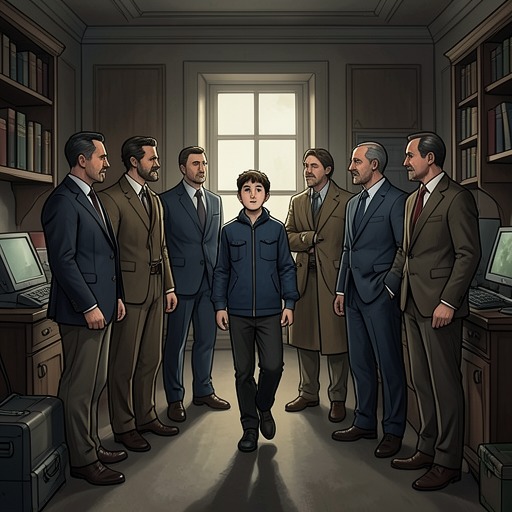
The early experiments depended on a breeding enterprise intended to produce a person capable of mastering time. One selected child’s brain was carefully controlled from infancy, and the child received severe psychological training. In the presence of scientists and historians, the child was put into a trance and brought out half an hour later. Asked to report the experience telepathically, the child was so shattered that the account was nearly unintelligible. After months of rest, the child described what appeared to be a terrifying incident from the girlhood of the child’s dead mother, apparently experienced through her eyes and with awareness of her thoughts. Because information might have come from a living mind, the episode did not establish access to the past.
Despite the child’s entreaties, the experiment was repeated. The child emerged with a rambling account of little red people in a squat white tower, which seemed to refer to the Great Brains and their attendants. This report also failed to settle the question; the child died before finishing it. A later adolescent subject endured an hour-long trance and described a scene attributed to the era of the Martian invasions: an old woman being helped from a house with a carved granite portico, while a formless monster descended a valley, destroyed the house, and mangled two people who had not escaped. The landscape had vanished, but excavation at the location identified from the account uncovered ancient slopes, a geological fault associated with the waterfall, and broken pillars. This and similar cases persuaded the Fifth Men that the past could indeed be inspected.
Dangers and limits of the early technique
Confirmation did not make the faculty safe. At first, a medium could not survive more than a few weeks after an excursion into the past. The experience seemed to cause progressive mental disintegration, leading from insanity to paralysis and then death. The Fifth Men eventually produced a type of brain able to withstand the strain, but control over where and how the mind travelled remained poor. Explorers could not choose the historical moment they visited; fate directed them, and access required a complicated procedure conducted with expert cooperation.
As the technique grew easier, it created new forms of harm. A medium could slip into trance so readily that weeks, months, or even years passed in an inert state, sustained by artificial feeding. Some were thrown among many different periods in a single day. Others experienced a month or a lifetime of events compressed into a day-long trance, or perceived events in reverse order. These distortions overwhelmed even the Fifth Men’s powerful brains, producing maniacal behaviour and death. The experience could also become compulsive: explorers, intoxicated by the past, tried to spend their whole lives there. Losing touch with their surroundings, they became socially ineffective and sometimes suffered physical disaster through neglect of their own care.
The perfected faculty
After many more thousands of years, the method was made safe enough for every individual to use at will, within limits, and to direct their vision toward a chosen region of space-time. Access nevertheless depended on a mind that had once inhabited the past: in practice the explorers entered human minds and, to a degree, those of higher mammals. The explorer did not become the past person or lose their own identity. They experienced that person’s perceptions, memories, thoughts, and desires while retaining their own character and memory, so that the same episode could provoke condemnation, sympathy, or critical enjoyment.
The Fifth Men explained the mechanism only by analogy. Access did not occur through a mysterious racial memory or a journey up the stream of time. Rather, the living brain partially awakened into eternity and inspected a small tract of space-time through a past mind, as through an optical instrument. The early distortions arose from disordered inspection: the novice might skim, linger, or read a sequence backwards, much as a reader can move through a book at different speeds or in reverse. Contact with the past itself occupied no time in the brain’s ordinary life, but absorbing the experience and converting it into normal memory required time during the trance. The faculty therefore exceeded ordinary temporal experience without making the brain’s work of understanding instantaneous.
Historical and cultural consequences
Supra-temporal Experience gave the Fifth Men a far more accurate knowledge of history, access to historical motives, and an intimate grasp of large-scale cultural movements. It also changed their valuation of the past. Earlier knowledge had been schematic, however extensive; now past lives could be encountered directly, limited only by the capacity of the exploring brain. The Fifth Men became, in effect, travellers through human time. What had seemed like ghostly presences became minds encountered with the vividness of immediate experience, and the present ceased to seem the sole real moment.
This experiential access also had a later ethical and practical role. The Last Men treated knowing and loving the human past as an act of filial piety, seeking to understand every mind they could enter, including the worst and least celebrated. Yet they also turned to the past for help with a task they found deeply uncongenial: designing and manufacturing an artificial human seed in vast quantities and projecting it among the stars. Their explorations of past struggles renewed a primitive commitment to life, giving them the zeal needed for that work even as they remained reconciled to their own fate. The faculty thus joined historical understanding to action: it made the past not only an object of intimate knowledge, but a source of resolve.